
November 13, 2026
By: Taweesak Chotivatanapong
Keywords: Mitral Valve
Rheumatic heart disease remains one of the leading causes of mitral valve dysfunction worldwide, particularly in developing countries where the disease continues to affect adolescents and young adults. Although mitral valve replacement has traditionally been the standard treatment for advanced rheumatic lesions, accumulated surgical experience has demonstrated that mitral valve repair provides excellent long-term outcomes while preserving native valve function and minimizing prosthetic valve-related complications.
The primary objective of rheumatic mitral valve repair is to restore normal valve competence through individualized anatomical reconstruction while preserving viable native valve tissue whenever feasible. Successful repair requires a comprehensive understanding of the pathological changes involving the mitral leaflets, commissures, annulus, chordae tendineae, papillary muscles, and the entire subvalvular apparatus.
Surgical Assessment and Procedure
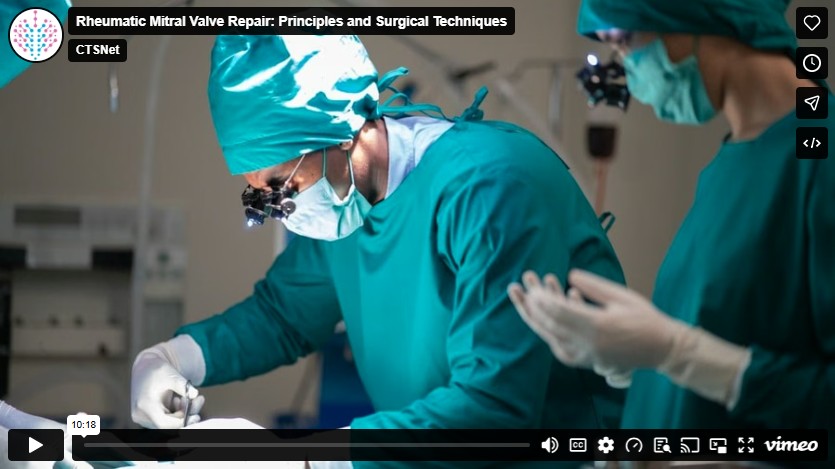
This video demonstrates the standardized surgical strategy developed and routinely practiced at the Central Chest Institute of Thailand (CCIT).
Following the initiation of cardiopulmonary bypass and left atriotomy, the mitral valve was systematically evaluated to identify the pathological mechanisms responsible for valve dysfunction. Careful assessment included leaflet mobility, commissural fusion, leaflet thickening, annular dilatation, calcification, chordal abnormalities, and subvalvular pathology.
Valve reconstruction began with meticulous mobilization of the mitral leaflets through careful removal of fibrotic tissue and restoration of leaflet flexibility whenever feasible. Commissurotomy was performed in the presence of commissural fusion to restore physiological leaflet opening while maintaining commissural support.
Leaflet reconstruction was individualized according to pathological findings and may include limited leaflet resection, leaflet remodeling, patch augmentation, or edge reconstruction to restore an adequate coaptation surface while preserving leaflet height and mobility.
The subvalvular apparatus was carefully examined for fused papillary muscles, shortened or thickened chordae, and restrictive lesions. Additional reconstructive procedures were performed as necessary to restore physiological leaflet motion and optimize valve function.
A complete prosthetic ring annuloplasty was subsequently performed to restore physiological annular geometry, improve leaflet coaptation, and enhance long-term durability of the repair. Valve competence was assessed by saline testing, followed by intraoperative transesophageal echocardiography, before separation from cardiopulmonary bypass.
Conclusion
The surgical strategy presented in this video reflects more than two decades of experience in rheumatic mitral valve repair at the CCIT. It emphasizes systematic anatomical assessment, preservation of native valve tissue, individualized reconstruction, restoration of leaflet mobility, optimization of the coaptation zone, correction of subvalvular pathology, and stabilization of the mitral annulus. These principles have become the cornerstone of the CCIT rheumatic mitral valve repair program and provide a reproducible educational framework for surgeons involved in complex mitral valve reconstruction.
Key Learnings
They key concepts to understand are:
Rheumatic mitral valve repair should be considered whenever durable anatomical reconstruction is feasible.
Systematic analysis of valve pathology is the key to successful repair.
Preservation of native valve tissue maintains physiological left ventricular function and minimizes prosthetic valve-related complications.
Standardized repair techniques improve reproducibility and long-term durability.
Careful patient selection combined with meticulous surgical technique remain the foundation of successful rheumatic mitral valve repair.
Disclaimer
The information and views presented on CTSNet.org represent the views of the authors and contributors of the material and not of CTSNet. Please review our full disclaimer page here.




 English